
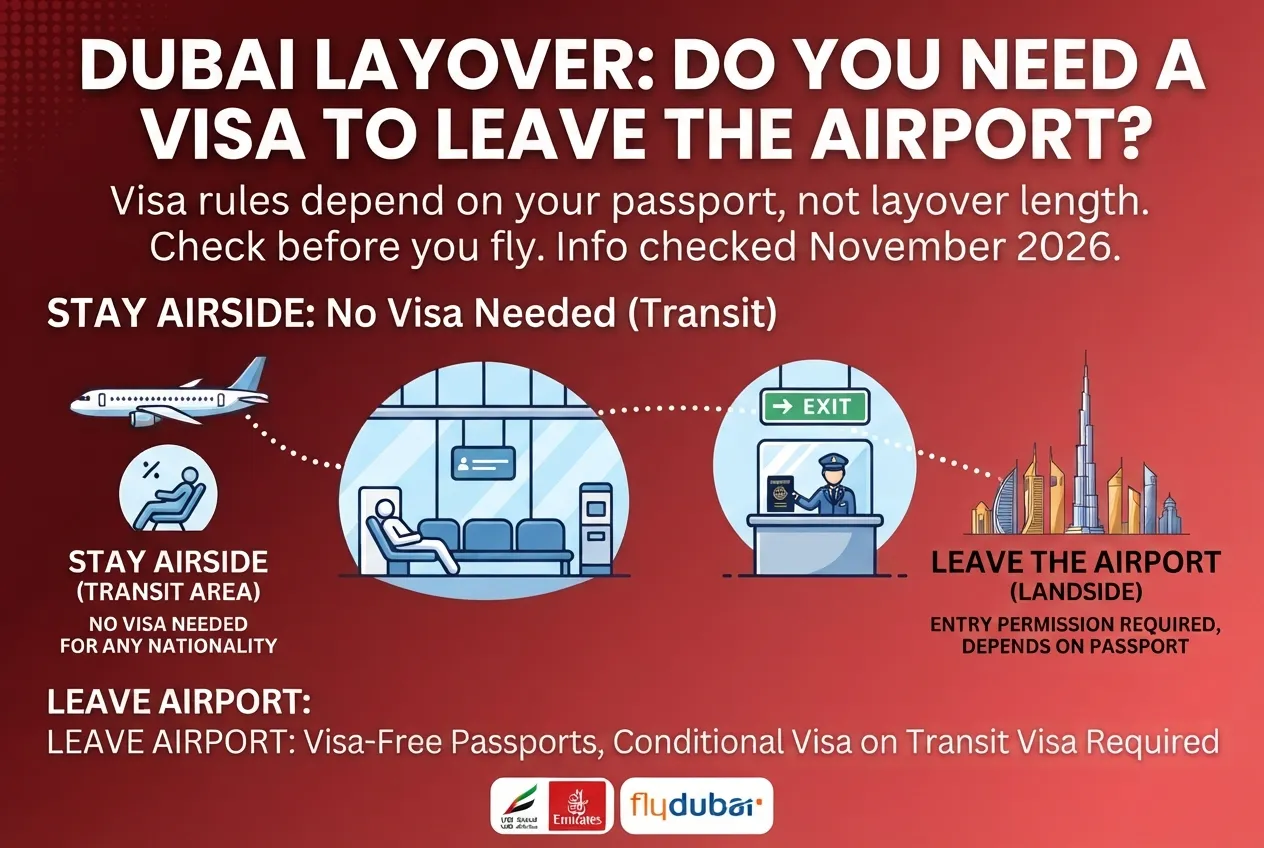
You do not need a visa to wait in the transit area of Dubai International Airport (DXB), but you do need UAE entry permission to pass passport control and step outside the terminal. What you need depends on your passport, not on how long your layover lasts.
- Staying airside: no UAE visa is needed for any nationality, provided you hold the documents your next country asks for.
- Visa-free passports: travellers with a United States, United Kingdom, Canadian, Australian, Chinese, Japanese or most EU passports can leave the airport without arranging anything in advance.
- Conditional visa on arrival: passport holders from India, Indonesia, Kenya, the Philippines, South Africa, Thailand and Vietnam qualify only with a valid residence permit from a listed country.
- Every other passport: a 48 hour or 96 hour UAE transit visa, or a tourist visa, must be arranged before you fly.
According to the UAE government portal, the 48 hour transit visa is free of charge and the 96 hour transit visa carries a AED 50 government fee (about US$13.60). Both need approval through a UAE-based airline such as Emirates or flydubai before you enter the country. If you would rather have someone handle the paperwork, you can apply for a 48 hour transit visa or a 96 hour transit visa with Emirates Visa UAE.
These rules were checked against UAE government and airline pages in November 2026. Entry rules change, so confirm them with your airline before you book.
Layover, transit and stopover: what each term means for your visa
You formally enter the United Arab Emirates when you clear passport control, and that is the moment a visa starts to matter. Before it, you are in the international transit area, known as airside.
| Term | Meaning | Visa effect |
|---|---|---|
| Layover | A connection between two flights, usually under 24 hours | None while you stay airside |
| Stopover | A longer planned stay, usually over 24 hours, in the connecting city | Entry permission needed, because you will leave the airport |
| Airside (transit area) | The secure zone after security, before passport control | No UAE visa for any nationality |
| Landside | The public side after passport control, including baggage reclaim and arrivals | Visa-free entry, visa on arrival or transit visa needed |
| Passport control | The immigration counters where the UAE admits or refuses entry | Your visa or entry permit is checked here |
| Through-checked baggage | Bags labelled to your final city on one ticket | You do not collect them in Dubai |
Baggage is the detail that trips up many travellers. On a single ticket, your bags are normally checked through and you can remain airside. On two separate tickets, you usually have to collect your bags and check in again, which sends you landside and through immigration even if you never meant to leave the airport.
Your onward destination’s entry rules still apply during the wait. Before boarding in Dubai, your airline will check that you hold any visa or travel authorisation your final country requires.
Which passports can leave Dubai airport without a transit visa?
Travellers from dozens of countries can clear immigration at DXB with no visa arranged beforehand, so a transit visa is only needed by everyone else. The table follows the June 2026 list published by Khaleej Times.
| Entry category | Permitted stay | Passports covered |
|---|---|---|
| GCC nationals, no visa | Passport or national ID | Bahrain, Kuwait, Oman, Qatar, Saudi Arabia |
| Visa-free | Up to 90 days within any 180 days | Includes the United States, United Kingdom, Canada, Australia, New Zealand, China, Japan, Singapore, South Korea, Switzerland and most EU member states |
| Visa-free | Up to 30 days | Andorra, Brunei, Hong Kong, Kazakhstan, Macau, Malaysia, Mauritius, Monaco, Mongolia, Republic of Ireland, Ukraine, Uzbekistan, Vatican City |
| Conditional visa on arrival | 14 or 60 days, depending on the category chosen | India, Indonesia, Kenya, Philippines, South Africa, Thailand, Vietnam, only with a valid residence permit from the US, EU, UK, Singapore, Japan, South Korea, Australia, New Zealand or Canada |
| All other passports | Transit visa or tourist visa | Must be arranged before travel |
The Khaleej Times article itself notes a mismatch between its headline figure of 49 countries in the 90 day group and the longer list it prints. Check your own passport against the official ICP or GDRFA Dubai list before relying on the table. Visa-free visitors may not work during their stay, and the UAE asks for a passport valid for at least six months from the date of entry.
South African passport holders deserve a specific mention. Without a qualifying residence permit from one of the listed countries, a South African passport needs a visa arranged in advance, which for a layover means a 48 hour or 96 hour transit visa or a tourist visa.
48 hour and 96 hour UAE transit visas: validity, fees and conditions
The UAE offers two transit visas, one lasting 48 hours and one lasting 96 hours. The federal Identity, Citizenship, Customs and Port Security authority (ICP) sets the rules for both. The details below come from the UAE government portal and the Emirates visa page.
| Attribute | 48 hour transit visa | 96 hour transit visa |
|---|---|---|
| Government fee | Free of charge | AED 50 |
| Validity | 48 hours from entry into the UAE | 96 hours from entry into the UAE |
| Minimum passport validity | 3 months | 6 months |
| Extension or renewal | Not possible | Not possible |
| Upgrade | Cannot be upgraded to 96 hours | Not applicable |
| Who sponsors it | A UAE-based airline | A UAE-based airline |
| Onward booking | Confirmed ticket to a third destination | Confirmed ticket to a third destination |
| Photo | Self-photo on a white background | Self-photo on a white background |
| Use window | Enter within 30 days of issue | Enter within 30 days of issue |
| Emirates listed price, including VAT | US$10 | US$49 |
| Emirates Visa UAE price | US$110 | US$130 |
A few notes on the fees. The AED 50 is the government fee for the 96 hour visa. Airlines list their own totals, and visa services such as Emirates Visa UAE charge a service price that covers handling the application for you, with standard processing of 2 to 3 days. The airline route can cost less when your whole booking is on Emirates, but it is closed to itineraries that include another carrier on the Dubai flights, and it asks you to apply well ahead. A visa service suits travellers whose tickets fall outside those conditions, or who want the paperwork checked before submission. Whichever route you choose, ask for the full price before you pay. Emirates states that its own transit visa fees are non-refundable.
The clock starts when you are admitted at passport control, not when you land. A 48 hour visa stamped at 10:00 on Monday means you must leave the UAE by 10:00 on Wednesday.
Who issues a Dubai transit visa and what documents you need
Only a UAE-based airline can sponsor a transit visa, and it must be approved before you enter the UAE. UAE carriers include Emirates and flydubai in Dubai, plus Etihad and Air Arabia. A travel agency or visa service can take care of the paperwork, but the application still runs through the airline.
Airline agents submit applications online through the ICP eChannels portal, the UAEICP smart app, or the GDRFA online channels of the relevant emirate. You do not file it yourself on a government site.
Documents for both visa types:
- A passport or travel document valid for at least 3 months (48 hour visa) or 6 months (96 hour visa).
- A recent photo of yourself on a white background.
- A confirmed onward booking to a third destination, which must not be the place you are arriving from.
- A confirmed ticket with a UAE-based airline that includes your Dubai stop.
Emirates adds conditions for its own customers. The booking must be a single confirmed Emirates reservation, every Dubai flight in it must be on Emirates, and the page asks you to apply at least four international working days before arrival. Itineraries with another carrier on the Dubai flights are not eligible for the online route.
The visa is tied to the airline that sponsored it. An Emirates transit visa is valid for travel on Emirates tickets outbound from Dubai, so you cannot sponsor it with one airline and then leave on another.
How to apply for a Dubai transit visa step by step
There are six steps, and the first one tells you whether you need to apply at all.
- Check your passport against the visa-free and visa on arrival lists above. If your passport is covered, you can skip the rest.
- Confirm your flights. Your ticket must be with a UAE-based airline, and your onward flight must leave within 48 or 96 hours of arrival, to a third destination.
- Gather your documents: a passport scan, a white background photo and your ticket details. Check that the passport has 3 months (48 hour visa) or 6 months (96 hour visa) of validity.
- Submit the request. Use your airline’s manage booking page, or let Emirates Visa UAE handle it. Pick the 48 hour or 96 hour transit visa, complete the online form, have your documents reviewed, and pay securely. The full process is laid out on the How to Apply page.
- Wait for approval. The e-visa arrives by email. Carry a printed or saved copy with your passport.
- Show your passport and approval at the DXB immigration counter. Your visa period starts when you are admitted, and you must leave the UAE inside that window.
Apply early. Emirates asks for at least four international working days before arrival, and its stopover terms ask for documents three working days ahead for 96 hour stays. Standard processing with Emirates Visa UAE takes 2 to 3 days, and applications sent on Fridays, Saturdays or public holidays may take longer. If your flight is close, the Expedited Service offers 24 hour processing from US$210, the Expedited Emergency visa offers 4 hour processing from US$470, and the Ultra Priority service offers 1 hour processing from US$960.
How long a layover do you need to leave Dubai airport?
The visa rules set no minimum layover, but passport control, travel time and the trip back to the terminal create a practical one. Treat the guide below as a rule of thumb, not an official rule.
| Layover length | Realistic plan | Visa angle |
|---|---|---|
| Under 6 hours | Stay airside and use the lounges, shops and restaurants | No visa needed |
| 6 to 10 hours | A short trip to Downtown Dubai, only if you can enter without a visa and queues are short | Visa-free or visa on arrival passports only |
| 10 to 24 hours | Dinner or an evening in the city, or a hotel rest | Visa-free entry, or a 48 hour transit visa |
| 24 to 48 hours | A full day of sightseeing and a night in a hotel | 48 hour transit visa, or visa-free entry |
| 48 to 96 hours | A short city break with day trips to Abu Dhabi or Sharjah | 96 hour transit visa, or visa-free entry |
Plan to be back at DXB about three hours before departure, which leaves time for passport control, check-in and security. The Dubai Metro Red Line takes roughly 25 minutes from Terminal 3 to Burj Khalifa/Dubai Mall station, so a Downtown Dubai trip is realistic once you allow for queues at both ends.
Emirates also runs a Dubai Connect programme for eligible passengers on long connections, bundling a hotel, meals, transfers and the visa where one is required. Layover windows and cabin rules depend on your booking, so read the conditions on emirates.com before assuming you qualify.
What to see with the time you have:
- Downtown Dubai: Burj Khalifa, The Dubai Mall and the Dubai Fountain.
- Old Dubai: Al Fahidi Historical District, the Gold Souk and an abra boat ride across Dubai Creek.
- Coast: Jumeirah Beach and the Palm Jumeirah.
- Abu Dhabi: Sheikh Zayed Grand Mosque, a day trip that suits a long layover or a 48 or 96 hour stay.
Dubai airports and terminals: where your layover happens
Dubai International Airport (DXB) is the airport most layovers use, and it handled a record 95.2 million passengers in 2025 according to Gulf News. Dubai Airports also operates Dubai World Central, known as Al Maktoum International (DWC), so check which airport your ticket names.
| Terminal | Main users | Gates | Dubai Metro access |
|---|---|---|---|
| Terminal 1 | A wide range of international airlines | D gates | Yes, Red Line |
| Terminal 2 | Selected scheduled, regional and charter services | F gates | No direct Metro link |
| Terminal 3 | Mainly Emirates, plus some other carriers | A, B and C gates | Yes, Red Line |
Terminal 2 is a separate building, so any connection involving it needs extra planning and a bigger time buffer. The terminal details come from a DXB terminal guide, and your airline can confirm how your own transfer works.
Most international connections are completed airside without entering the UAE, so no visa is needed. Entry eligibility only matters when your itinerary forces you through passport control, for instance a self-transfer on separate tickets that makes you collect and re-check bags.
For a trip into the city, the Dubai Metro Red Line serves the Terminal 1 and Terminal 3 stations and reaches Downtown Dubai without a taxi. You need a Nol card to travel on the Metro.
Common Dubai layover visa mistakes to avoid
Most layover visa problems come from timing and ticket rules rather than from the visa itself. These are the ones that matter.
- Arriving without approval: the UAE government says a transit visa must be processed and approved before you enter the UAE, so do not plan to collect one at the airport.
- Using the wrong airline: the visa must be sponsored by a UAE-based airline, and an Emirates visa is valid with Emirates tickets outbound from Dubai.
- Booking the wrong onward flight: the onward booking must go to a third destination, not back to the country you came from.
- Short passport validity: the passport needs 3 months for the 48 hour visa and 6 months for the 96 hour visa.
- Expecting an extension: neither visa can be extended or renewed, and a 48 hour visa cannot be upgraded to 96 hours, so choose the right one at the start.
- Applying late: Emirates asks for at least four international working days before arrival, and weekend or holiday submissions can add processing time.
- Buying separate tickets: two tickets often mean collecting bags and clearing immigration, which turns a simple connection into an entry.
- Overstaying: the visa period runs from the moment you are admitted, so count from your immigration stamp, not from landing.
- Forgetting your next country: your final destination may need its own visa or authorisation, and the airline will check it before boarding.
If any agency or website quotes a price well above the official fees, ask for a breakdown. The government fee is free for 48 hours and AED 50 for 96 hours, and the remainder is a service and processing charge.
Dubai layover visa FAQs
Do I need a visa for a layover in Dubai if I stay inside the airport? No. Passengers who stay in the international transit area do not pass UAE immigration, so no UAE visa is needed for any nationality. You still need whatever your next country requires.
Do I need a visa to leave Dubai airport with a US, UK or EU passport? No advance visa is needed. Passports from the United States, United Kingdom, Canada, Australia and most EU countries are on the visa-free list for up to 90 days within any 180 days, and the Republic of Ireland is on the 30 day list.
Do South Africans need a visa for a Dubai layover? Most South African passport holders do. The visa on arrival route applies only with a valid residence permit from a listed country such as the US, UK, EU, Singapore, Japan, South Korea, Australia, New Zealand or Canada. Without one, you need a 48 hour or 96 hour transit visa or a tourist visa arranged before you fly.
How much is a Dubai transit visa? The government fee is free for the 48 hour visa and AED 50 for the 96 hour visa. Airlines and visa services add their own charges. Emirates lists US$10 and US$49 including VAT for its own customers, and Emirates Visa UAE lists US$110 for the 48 hour visa and US$130 for the 96 hour visa.
How long is a UAE transit visa valid? It is valid for 48 or 96 hours from the moment you enter the UAE, and you must use it within 30 days of issue. You must leave the country before the window ends.
Can I extend a Dubai transit visa? No. Neither transit visa can be extended or renewed, and a 48 hour visa cannot be upgraded to 96 hours.
Can I get a transit visa at Dubai airport when I arrive? The UAE government says the visa must be processed and approved before you enter the UAE, so arrange it in advance.
Can I apply for a transit visa myself? Not directly. Only UAE-based airlines can sponsor a transit visa. Travel agencies and visa services submit the request on your behalf.
How fast can I get a Dubai transit visa through Emirates Visa UAE? Standard processing takes 2 to 3 days. Faster options are available if your flight is close: 24 hour processing from US$210, 4 hour processing from US$470 and 1 hour processing from US$960. Applications sent on Fridays, Saturdays or public holidays may need extra time.
Does Emirates give a free visa on a long layover? Emirates runs a Dubai Connect programme for eligible passengers that can include a hotel, meals, transfers and the visa where one is needed. Eligibility depends on your layover length, cabin and booking, so confirm it on emirates.com.
What is the difference between a layover and a stopover in Dubai? A layover is a connection of usually under 24 hours, while a stopover is a longer planned stay in the connecting city. Both need the same entry permission if you leave the airport.
Plan your Dubai layover with the right visa
You can always stay airside at DXB without a visa, and you can only leave the airport freely if your passport is visa-free or you hold the right entry permission. Check your passport first, confirm your ticket is with a UAE-based airline, and arrange a 48 hour or 96 hour transit visa before you fly if you need one.
Emirates Visa UAE is a Dubai-based visa service that handles 48 hour and 96 hour transit visa applications online. Choose the 48 hour transit visa or the 96 hour transit visa that matches your layover, or contact the team if you are unsure which one fits. Planning a longer trip? See the tourist visa options and the FAQs.